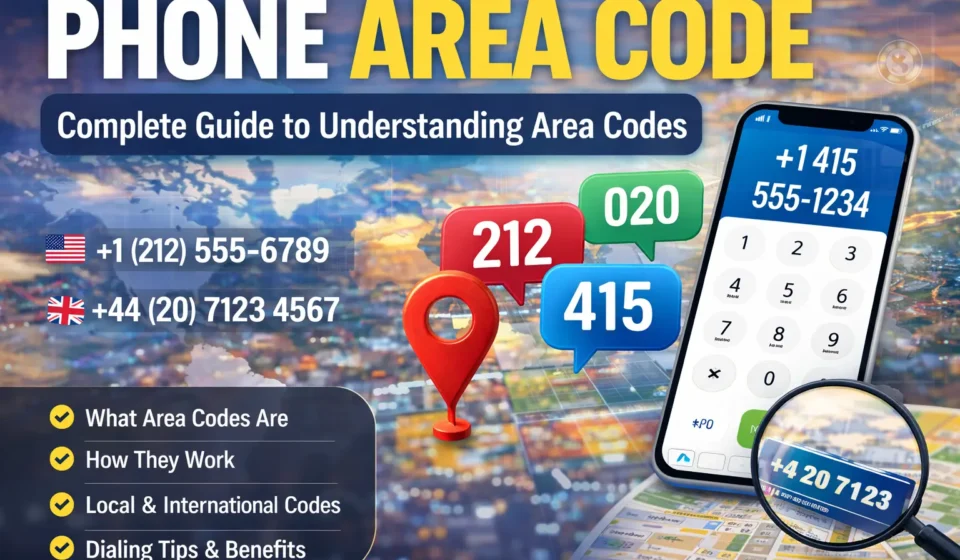

A phone area code is one of the most important parts of a telephone number. It helps telephone networks identify where a call should be routed geographically. Whether you’re dialing a local number, calling another city, or contacting someone internationally, the area code plays a crucial role in connecting the call correctly.
For decades, area codes have been the backbone of the telephone numbering system. They allow billions of calls to be routed quickly and accurately across cities, states, and countries.
In this comprehensive guide, you will learn everything about phone area codes, including:
-
What a phone area code is
-
How the numbering system works
-
Why area codes exist
-
How new area codes are created
-
Area code overlays and splits
-
Examples from different countries
-
How businesses use area codes for marketing and operations
This article explains the topic from beginner to advanced level, making it useful for everyday phone users, businesses, telecom professionals, and anyone curious about how telephone systems function.
What Is a Phone Area Code?
A phone area code is a numeric prefix at the beginning of a phone number that identifies a specific geographic region within a telephone network.
In many countries, especially in North America, area codes consist of three digits and appear before the local phone number.
Example phone number:
(212) 555-1234
Here’s the breakdown:
| Number Part | Meaning |
|---|---|
| 212 | Area code |
| 555 | Central office code |
| 1234 | Subscriber number |
The area code tells the telephone network which region the call is intended for, allowing the system to route it properly.
History of Phone Area Codes
Area codes were introduced to solve a growing problem in the telecommunications industry: the increasing number of telephone users.
In the early days of telephones, operators manually connected calls. As telephone usage expanded, automated dialing systems became necessary.
Area codes were introduced as part of the North American Numbering Plan (NANP) in 1947.
The system allowed telephone networks to:
-
Automate call routing
-
Reduce operator involvement
-
Support millions of phone numbers
Originally, only 86 area codes existed in North America. Today, there are hundreds.
The rapid growth of mobile phones, fax machines, and internet services has required the continuous creation of new area codes.
Structure of a Phone Number
Understanding the structure of a phone number helps explain where the area code fits.
In many countries, a phone number contains several components.
Example:
(415) 867-5309
| Part | Description |
|---|---|
| Country Code | Identifies the country |
| Area Code | Identifies the region |
| Central Office Code | Identifies the exchange |
| Line Number | Unique subscriber number |
For example:
+1 (415) 867-5309
-
+1 → Country code
-
415 → Area code
-
867 → Exchange
-
5309 → Line number
Why Phone Area Codes Exist
Area codes serve several important purposes.
1. Geographic Identification
Area codes identify a specific geographic location.
For example:
-
212 – New York City
-
213 – Los Angeles
-
305 – Miami
This allows the network to route calls efficiently.
2. Efficient Call Routing
Without area codes, telephone systems would struggle to determine where calls should go.
Area codes help:
-
Direct calls to the correct switching center
-
Prevent routing errors
-
Speed up call connections
3. Supporting Massive Phone Networks
Today, billions of phone numbers exist globally. Area codes make it possible to organize these numbers logically.
They allow telecom systems to:
-
Expand numbering capacity
-
Prevent number duplication
-
Manage regional telecommunications infrastructure
How Phone Area Codes Work
Area codes function through a system of telephone switching networks.
When you dial a phone number:
-
The system reads the country code
-
It identifies the area code
-
The call is routed to a regional switching center
-
The network forwards the call to the local exchange
-
The call connects to the specific subscriber line
This entire process happens in milliseconds.
Types of Phone Area Codes
Area codes can be categorized in several ways.
1. Geographic Area Codes
These are the most common.
They correspond to specific physical regions such as cities or states.
Examples:
-
New York City → 212
-
Chicago → 312
-
Dallas → 214
2. Overlay Area Codes
An overlay occurs when multiple area codes serve the same geographic area.
Example:
A city originally used one area code but added another due to demand.
Benefits:
-
No need to change existing numbers
-
Provides additional numbering capacity
3. Split Area Codes
An area code split divides a region into two separate zones.
Example:
One part keeps the original area code, while the other receives a new one.
Drawback:
-
Many users must change phone numbers
4. Non-Geographic Area Codes
Some area codes are not tied to a specific location.
Examples include:
-
Toll-free numbers
-
Premium services
-
Virtual phone services
These codes allow businesses to operate nationwide.
Examples of Popular Phone Area Codes
Here are examples of widely recognized area codes.
| Area Code | Location |
|---|---|
| 212 | New York City |
| 213 | Los Angeles |
| 305 | Miami |
| 415 | San Francisco |
| 617 | Boston |
| 702 | Las Vegas |
These codes often become associated with the identity of their cities.
Phone Area Codes Around the World
Different countries use different numbering systems.
Some countries have short area codes, while others use longer ones.
Examples:
| Country | Example Area Code |
|---|---|
| United States | 212 |
| United Kingdom | 020 (London) |
| Australia | 02 (Sydney) |
| Germany | 030 (Berlin) |
| Japan | 03 (Tokyo) |
Although formats vary, the principle remains the same: area codes identify a region within the national phone system.
How New Area Codes Are Created
As populations grow and more devices require phone numbers, existing area codes may run out of available numbers.
When this happens, telecom authorities introduce new area codes.
Two main methods are used:
Area Code Split
A region is divided into two geographic zones.
Area Code Overlay
A new area code is added to the same geographic region.
Overlays are now more common because they do not require existing numbers to change.
Impact of Mobile Phones on Area Codes
The rise of smartphones dramatically increased demand for phone numbers.
Each mobile phone requires its own number, and many people have multiple devices.
Additional demand comes from:
-
Tablets
-
Smartwatches
-
Business phone systems
-
Virtual phone numbers
As a result, many cities now use multiple area codes.
Benefits of Phone Area Codes
Area codes offer several advantages.
Organized Telephone Systems
They divide large networks into manageable regions.
Improved Call Routing
Calls reach their destinations faster and more accurately.
Number Expansion
New area codes allow telecom providers to add millions of numbers.
Regional Identity
Some area codes become cultural symbols associated with cities.
Challenges and Limitations
Despite their benefits, area codes also create some challenges.
Number Exhaustion
High demand for phone numbers can quickly exhaust an area code.
Public Confusion
New area codes sometimes confuse residents and businesses.
Mandatory 10-Digit Dialing
In overlay regions, callers must dial the full 10-digit number, even for local calls.
Phone Area Codes and Business Strategy
Businesses often use area codes strategically.
Local Presence
A business may choose a local area code to appear familiar to customers.
Example:
A company serving Los Angeles might use a 213 number.
Marketing Benefits
Customers often trust businesses that appear local.
Local area codes can improve:
-
Response rates
-
Customer engagement
-
Brand credibility
Virtual Phone Numbers
Modern communication systems allow companies to purchase virtual numbers with specific area codes.
This enables businesses to:
-
Operate in multiple cities
-
Route calls to one central office
-
Expand without physical offices
How to Find a Phone Area Code
If you need to find an area code, there are several ways.
Method 1: Identify the City
Most area codes correspond to specific cities or regions.
Method 2: Use Online Lookup Tools
Area code directories help match cities with codes.
Method 3: Check the Phone Number
The first three digits of a number usually represent the area code.
Phone Area Codes vs Country Codes
Area codes are often confused with country codes.
Here is the difference.
| Feature | Area Code | Country Code |
|---|---|---|
| Purpose | Identifies region within a country | Identifies the country |
| Digits | Usually 2–3 digits | 1–3 digits |
| Example | 415 | +1 |
Example international call:
+1 415 555 1234
-
+1 → United States
-
415 → Area code
Future of Phone Area Codes
Telecommunication systems continue evolving.
Future changes may include:
-
Additional overlay codes
-
Expanded numbering capacity
-
Increased use of virtual numbers
However, area codes will likely remain a fundamental part of the global telephone system.
Frequently Asked Questions (FAQs)
What is a phone area code?
A phone area code is a set of digits that identifies a geographic region within a country’s telephone system. It helps route calls to the correct local network.
How many digits are in an area code?
Most area codes contain two or three digits, depending on the country. In North America, area codes typically use three digits.
Why do some cities have multiple area codes?
Cities add additional area codes when the original code runs out of available phone numbers. This happens due to population growth and increasing demand for mobile devices.
Can two locations share the same area code?
Yes. In overlay systems, multiple area codes can serve the same geographic region, meaning residents in the same city may have different area codes.
Are area codes tied to mobile phones?
Not always. Originally, area codes represented geographic locations, but with mobile phones and number portability, people can keep the same number even after moving to a different region.
Key Takeaways
Understanding phone area codes helps you better navigate modern communication systems.
Important points:
-
Area codes identify regions within a telephone network
-
They allow efficient call routing across cities and countries
-
Growing demand for phone numbers has created hundreds of area codes
-
Businesses use area codes for branding and local presence
-
Mobile technology and virtual numbers continue expanding the numbering system
Conclusion
Phone area codes are a critical component of global telecommunications. They make it possible for billions of phone calls to be routed accurately every day, connecting people across cities, countries, and continents.
From their origins in early automated telephone systems to their modern use in mobile and virtual communication networks, area codes have evolved to meet the growing demands of a connected world.
Whether you’re making personal calls, managing business communications, or analyzing telecom infrastructure, understanding phone area codes provides valuable insight into how modern communication works.
Actionable takeaway:
Always include the correct area code when dialing or registering a phone number. This ensures calls connect quickly, prevents routing errors, and supports efficient communication in an increasingly global digital environment.