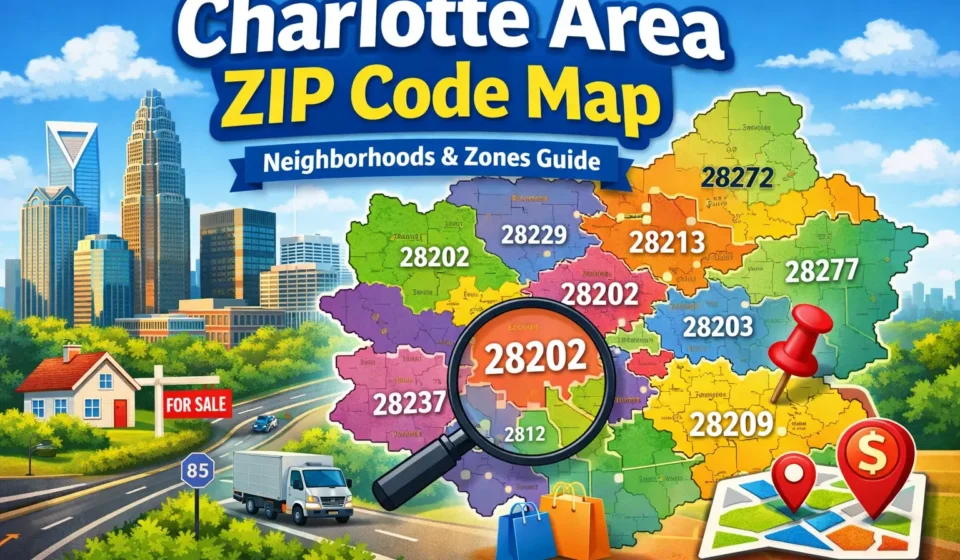

The Charlotte area ZIP code map is more than just a set of numbers on a map. It represents neighborhoods, communities, economic zones, and service areas across one of the fastest-growing cities in the United States. Whether you’re moving to the area, planning logistics, analyzing demographics, or launching a business, understanding Charlotte’s ZIP code structure can help you make smarter decisions.
Located in the state of Charlotte, Charlotte has experienced rapid growth over the last decade. As the largest city in North Carolina, it contains dozens of ZIP codes covering urban districts, suburban communities, and nearby towns.
This comprehensive guide will explain:
- What the Charlotte ZIP code map is
- How ZIP codes are organized across the metro area
- Key ZIP codes and neighborhoods
- How businesses and residents use ZIP code maps
- Benefits, limitations, and practical applications
By the end, you’ll have a deep understanding of how Charlotte’s ZIP code system works and how to use it effectively.
What Is a Charlotte Area ZIP Code Map?
A Charlotte area ZIP code map visually displays all postal ZIP codes within Charlotte and its surrounding communities.
ZIP codes are numerical codes used to identify geographic delivery areas for the United States Postal Service.
Quick Definition
A ZIP code map is a geographic representation that divides a city or region into postal delivery zones identified by five-digit codes.
Why ZIP Codes Exist
ZIP codes were introduced to improve mail sorting and delivery efficiency. Each code identifies a specific region, making it easier for mail carriers to organize routes.
In Charlotte, ZIP codes cover:
- Downtown districts
- Residential suburbs
- Commercial centers
- Industrial zones
- Surrounding towns
Understanding How ZIP Codes Work in Charlotte
ZIP codes follow a structured system designed for efficiency.
Structure of a ZIP Code
A ZIP code contains five digits.
Example: 28202
Each part represents a geographic level.
| ZIP Code Section | Meaning |
|---|---|
| First Digit | Broad geographic region |
| First Three Digits | Sectional center facility |
| Last Two Digits | Local post office area |
Charlotte ZIP codes generally start with 282.
Complete Charlotte Area ZIP Code Map Overview
The Charlotte metro region includes numerous ZIP codes covering different neighborhoods and districts.
Below is a simplified overview of major Charlotte ZIP codes.
| ZIP Code | Area |
|---|---|
| 28202 | Uptown Charlotte |
| 28203 | Dilworth / South End |
| 28204 | Elizabeth |
| 28205 | Plaza Midwood |
| 28206 | North Charlotte |
| 28207 | Eastover |
| 28208 | West Charlotte |
| 28209 | Myers Park |
| 28210 | South Charlotte |
| 28211 | Cotswold |
| 28212 | East Charlotte |
| 28213 | University Area |
| 28214 | Mountain Island |
| 28215 | East Charlotte suburbs |
| 28216 | North Charlotte suburbs |
| 28217 | Airport area |
| 28226 | South Charlotte |
| 28227 | Mint Hill |
| 28262 | University City |
These ZIP codes form the backbone of the Charlotte area ZIP code map.
Major Neighborhoods by ZIP Code
Charlotte neighborhoods often align closely with ZIP codes, helping residents identify communities easily.
Uptown Charlotte – ZIP Code 28202
Uptown Charlotte is the city’s financial and business center.
Highlights:
- Major banking headquarters
- Corporate offices
- Entertainment districts
- High-rise apartments
It represents the urban core of Charlotte.
South End and Dilworth – ZIP Code 28203
This area is known for its vibrant culture and walkability.
Features include:
- Breweries
- Restaurants
- Art galleries
- Historic homes
Young professionals often choose this area for its lifestyle and accessibility.
Myers Park – ZIP Code 28209
Myers Park is one of Charlotte’s most prestigious residential neighborhoods.
Key characteristics:
- Tree-lined streets
- Luxury homes
- Top schools
- Quiet suburban atmosphere
University Area – ZIP Code 28213
The University Area surrounds University of North Carolina at Charlotte.
Common features:
- Student housing
- Research facilities
- Technology parks
- Affordable apartments
East Charlotte – ZIP Codes 28212 & 28215
East Charlotte is a diverse and rapidly growing region.
Benefits include:
- Affordable housing
- International restaurants
- Family communities
Charlotte Metropolitan ZIP Code Map
The broader Charlotte metropolitan area includes nearby towns and counties.
These areas interact economically with Charlotte.
Nearby Cities with Related ZIP Codes
| City | Example ZIP Code |
|---|---|
| Concord | 28025 |
| Huntersville | 28078 |
| Matthews | 28105 |
| Pineville | 28134 |
| Gastonia | 28052 |
These communities expand the reach of the Charlotte metro area.
Why Charlotte ZIP Codes Matter
ZIP codes serve important roles beyond mail delivery.
1. Real Estate Market Analysis
Real estate professionals rely on ZIP codes to track housing trends.
Data tracked by ZIP code includes:
- Median home price
- Rental rates
- Population growth
- School ratings
Some Charlotte ZIP codes experience faster property value growth than others.
2. Business Location Strategy
Businesses often analyze ZIP codes when choosing locations.
ZIP code data helps determine:
- Target demographics
- Average income levels
- Consumer demand
- Population density
Retail chains and restaurants frequently use ZIP code analytics to optimize expansion.
3. Logistics and Delivery Optimization
Delivery companies rely heavily on ZIP codes.
Benefits include:
- Route optimization
- Faster shipping
- Reduced fuel costs
Large e-commerce companies design distribution networks around ZIP code clusters.
4. Marketing and Advertising
Marketers use ZIP codes to target audiences more effectively.
Examples include:
- Direct mail campaigns
- Digital ad targeting
- Market segmentation
ZIP codes allow businesses to tailor promotions to specific communities.
How to Read a Charlotte Area ZIP Code Map
Understanding a ZIP code map requires recognizing several elements.
Key Components
A typical map includes:
- Color-coded ZIP zones
- Major roads and highways
- Neighborhood boundaries
- City limits
Maps also highlight landmarks like airports and universities.
Benefits of Using a ZIP Code Map
ZIP code maps provide several advantages.
1. Easy Geographic Navigation
They simplify the process of identifying regions and neighborhoods.
2. Improved Planning
Urban planners use ZIP code maps to plan infrastructure and services.
3. Better Business Insights
Companies can evaluate market demand by ZIP code.
4. Accurate Demographic Analysis
ZIP codes help analyze population patterns and growth trends.
Limitations of ZIP Code Maps
Despite their usefulness, ZIP codes have some limitations.
Not Exact Neighborhood Boundaries
ZIP codes were designed for mail delivery, not neighborhood identity.
Frequent Changes
As cities grow, ZIP codes can be adjusted or reassigned.
Population Differences
Some ZIP codes cover large populations, while others are relatively small.
Real-World Use Cases
Case Study: Restaurant Expansion
A restaurant chain planning to open a new location might analyze Charlotte ZIP codes to identify areas with:
- High population density
- Strong income levels
- Limited competition
The chain may discover that ZIP code 28203 offers strong demand due to nightlife and young professionals.
Case Study: Delivery Service Optimization
A logistics company may analyze delivery patterns across Charlotte ZIP codes.
By grouping deliveries by ZIP code, they can:
- Reduce travel time
- Improve customer satisfaction
- Lower operating costs
Charlotte ZIP Codes by Region
Below is a simplified breakdown.
Central Charlotte
- 28202
- 28203
- 28204
South Charlotte
- 28209
- 28210
- 28226
East Charlotte
- 28205
- 28212
- 28215
North Charlotte
- 28206
- 28213
- 28216
West Charlotte
- 28208
- 28214
Comparing Charlotte ZIP Codes
Different ZIP codes offer unique characteristics.
| ZIP Code | Area Type | Typical Residents |
|---|---|---|
| 28202 | Urban | Professionals |
| 28203 | Mixed | Young professionals |
| 28209 | Upscale | Families |
| 28213 | University | Students |
| 28212 | Diverse | Families & immigrants |
These differences influence housing, retail, and lifestyle options.
How Professionals Use Charlotte ZIP Code Data
Professionals across industries rely on ZIP code analysis.
Real Estate Agents
Agents analyze home sales data by ZIP code.
Healthcare Providers
Hospitals evaluate patient distribution across ZIP codes.
Retail Chains
Retailers evaluate foot traffic and demographics.
City Planners
Government agencies use ZIP code data for planning infrastructure.
Tips for Using a Charlotte ZIP Code Map
Here are practical tips.
1. Compare ZIP Codes Before Moving
Evaluate housing prices, schools, and safety levels.
2. Analyze Demographics
Businesses should review population data before launching.
3. Consider Commuting Routes
Some ZIP codes offer better access to highways and transit.
4. Review Future Development Plans
Emerging neighborhoods may experience rapid growth.
People Also Ask (FAQ)
What is the main ZIP code for Charlotte?
The most central ZIP code is 28202, covering Uptown Charlotte, the city’s primary business district.
How many ZIP codes are in Charlotte?
Charlotte contains more than 30 ZIP codes, covering urban and suburban areas.
What ZIP code covers downtown Charlotte?
Downtown, also known as Uptown Charlotte, is primarily served by ZIP code 28202.
Are ZIP codes the same as neighborhoods?
No. ZIP codes are postal delivery zones and may include multiple neighborhoods.
What is the largest ZIP code in Charlotte?
ZIP code 28277 is one of the largest suburban areas and includes parts of south Charlotte.
Quick ZIP Code List
Some commonly searched Charlotte ZIP codes include:
- 28202
- 28203
- 28205
- 28207
- 28209
- 28210
- 28211
- 28213
- 28226
- 28262
These appear frequently on Charlotte area ZIP code maps used by residents and businesses.
Future Growth of Charlotte ZIP Codes
Charlotte continues to grow rapidly.
Population increases are driving:
- New housing developments
- Infrastructure expansion
- Potential ZIP code adjustments
Urban growth is expected to continue across the metropolitan region for years to come.
Conclusion
The Charlotte area ZIP code map is an essential tool for understanding the structure and dynamics of one of America’s fastest-growing cities. From identifying neighborhoods to analyzing business opportunities, ZIP codes provide valuable geographic insights.
Key takeaways:
- Charlotte ZIP codes typically begin with 282.
- Different ZIP codes reflect unique neighborhoods and communities.
- Businesses, residents, and planners rely on ZIP code data daily.
- ZIP code maps simplify navigation, market analysis, and urban planning.
Whether you’re relocating, starting a business, or simply exploring Charlotte’s geography, understanding its ZIP code system gives you a clearer picture of the city’s layout and opportunities.
By learning how to read and interpret a Charlotte area ZIP code map, you can make better decisions and gain deeper insight into this dynamic metropolitan region.