
ZIP codes are a fundamental part of modern mail delivery in the United States. Most people use them daily when sending packages, filling out forms, ordering products online, or verifying addresses. Yet many people still ask the same question:
How are ZIP codes determined?
The answer involves geography, population distribution, postal logistics, and a sophisticated organizational system developed to make mail delivery faster and more accurate.
In this comprehensive guide, you’ll learn:
- What ZIP codes are
- Why they exist
- How ZIP codes are determined
- How the numbering system works
- How new ZIP codes are created
- Real-world examples and applications
- Common misconceptions about ZIP codes
Whether you’re a beginner, researcher, business professional, or data analyst, this guide explains everything from the basics to the deeper structure behind ZIP code assignment.
What Is a ZIP Code?
A ZIP code is a numeric postal code used to identify a specific geographic delivery area within the United States postal system.
The term ZIP stands for:
Zone Improvement Plan
The ZIP code system was introduced to make sorting and delivering mail faster and more efficient.
Basic ZIP Code Format
A standard ZIP code contains five digits.
Example:
90210
Each digit has meaning:
| Digit | Purpose |
|---|---|
| 1st digit | National region |
| 2nd–3rd digits | Regional processing center |
| 4th–5th digits | Local post office or delivery area |
Later, an expanded format called ZIP+4 was introduced.
Example:
90210-1234
The additional four digits help identify:
- A specific building
- A group of apartments
- A specific company
- A mail route
Why ZIP Codes Exist
Before ZIP codes were introduced, mail delivery relied heavily on human memory and local knowledge. As the population grew, mail volume increased dramatically.
Sorting mail became slower and more prone to mistakes.
ZIP codes solved several major problems.
Key Purposes of ZIP Codes
1. Faster Mail Sorting
Sorting centers can quickly route mail using numeric codes rather than reading full addresses.
2. Efficient Delivery Routes
Postal workers can organize delivery routes based on ZIP code zones.
3. Reduced Errors
Numbers reduce confusion between similar city names or street names.
4. Automation
Modern sorting machines read ZIP codes automatically.
5. Logistics Optimization
Shipping companies use ZIP codes to calculate delivery times and shipping costs.
How Are ZIP Codes Determined?
Now let’s answer the main question:
How are ZIP codes determined?
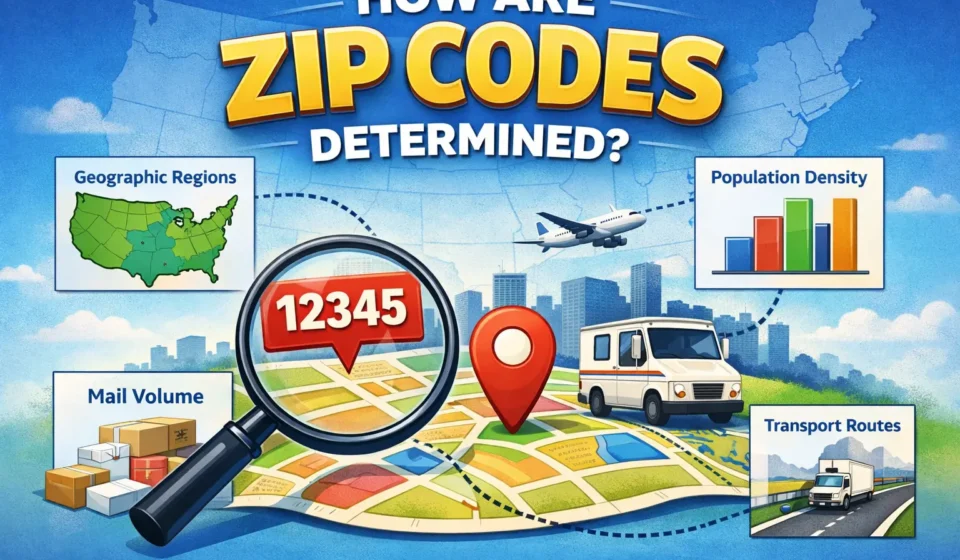
ZIP codes are determined by analyzing mail volume, geographic regions, transportation routes, and population density.
Postal planners create ZIP code areas based on how mail flows through the delivery network.
The goal is not to define neighborhoods or city boundaries — the goal is efficient mail delivery.
Several factors influence ZIP code design.
Factors That Determine ZIP Codes
1. Geographic Regions
The United States is divided into 10 large postal regions.
Each region begins with a specific starting number.
Example:
| First Digit | Region |
|---|---|
| 0 | Northeast |
| 1 | Mid-Atlantic |
| 2 | Southeast |
| 3 | Southern states |
| 4 | Midwest |
| 5 | Central Plains |
| 6 | South Central |
| 7 | Texas and surrounding |
| 8 | Mountain states |
| 9 | West Coast |
This is why ZIP codes in nearby states often start with the same digit.
2. Sectional Center Facilities (SCF)
The second and third digits represent a major mail processing facility called a Sectional Center Facility.
These centers process large volumes of mail for a region.
Example:
| ZIP Code | Processing Area |
|---|---|
| 100xx | New York City |
| 303xx | Atlanta |
| 606xx | Chicago |
| 900xx | Los Angeles |
Mail is routed first to the correct regional center before local delivery.
3. Local Post Offices
The last two digits of a ZIP code identify the specific local delivery post office.
This means each post office or delivery zone receives a specific range of ZIP codes.
Example:
30301
30302
30303
These may all belong to the same metro region but serve different delivery routes.
4. Population Density
Areas with higher populations usually have more ZIP codes.
Example:
Large cities may have dozens of ZIP codes.
Rural areas may share one ZIP code across multiple towns.
This happens because:
- Cities receive much more mail
- Delivery routes must be smaller
- Sorting needs to be more precise
5. Mail Volume
Mail volume is one of the biggest factors.
If a region begins receiving significantly more mail, the postal system may:
- Split a ZIP code into two
- Add ZIP+4 segments
- Create a new delivery zone
Large businesses sometimes even receive their own ZIP code due to extremely high mail volume.
6. Transportation Routes
ZIP code areas often follow major transportation routes such as:
- Highways
- Rail lines
- Air cargo routes
- Distribution centers
Mail is designed to move along the fastest logistical paths.
This makes ZIP codes partially based on transport efficiency rather than strict geography.
How the ZIP Code Numbering System Works
The numbering system follows a geographic pattern across the United States.
ZIP codes generally increase from east to west.
Example
| City | ZIP Code |
|---|---|
| Boston | 02108 |
| New York | 10001 |
| Chicago | 60601 |
| Dallas | 75201 |
| Denver | 80201 |
| Los Angeles | 90001 |
Notice the numbers increase as you move westward.
This makes nationwide mail routing easier.
Understanding ZIP+4 Codes
The ZIP+4 system was introduced to improve precision.
Example:
10001-1234
The extra four digits identify smaller delivery segments.
These could represent:
- A single apartment building
- A group of offices
- A specific floor
- A mail route
- A PO Box group
Benefits of ZIP+4
- Faster automated sorting
- Reduced delivery errors
- Improved logistics accuracy
- Better address validation
Businesses that send large volumes of mail rely heavily on ZIP+4 codes.
Who Creates and Assigns ZIP Codes?
ZIP codes are assigned by the United States Postal Service (USPS).
The USPS analyzes:
- Mail flow data
- Population changes
- New housing developments
- Business districts
- Delivery efficiency
When needed, they update ZIP code boundaries.
However, these changes happen slowly to avoid confusion.
When New ZIP Codes Are Created
New ZIP codes may be created under certain conditions.
Common Reasons
1. Rapid Population Growth
New housing developments may require additional delivery zones.
2. Increased Mail Volume
Large business districts may overwhelm existing ZIP codes.
3. New Cities or Municipal Changes
Urban expansion sometimes requires postal restructuring.
4. Large Organizations
Some institutions receive unique ZIP codes.
Examples include:
- Universities
- Government agencies
- Large corporations
Real-World Examples of ZIP Code Assignment
Understanding how ZIP codes are determined becomes easier with examples.
Example 1: Large City
Major cities often have dozens of ZIP codes.
Reasons include:
- Dense population
- Multiple post offices
- Complex delivery routes
Example scenario:
City Population: 2 million
ZIP Codes: 40+
Each ZIP code represents smaller delivery zones.
Example 2: Rural Areas
Rural regions may share one ZIP code across multiple towns.
Example:
Population: 8,000
ZIP Codes: 1
Mail volume is lower, so a single delivery area works efficiently.
Example 3: Corporate ZIP Codes
Large companies that receive massive mail volumes sometimes get unique ZIP codes.
Reasons include:
- Millions of letters annually
- Dedicated mail sorting
- Improved logistics
This helps speed up processing.
How Businesses Use ZIP Codes
ZIP codes are not only for mail delivery.
They are widely used in business analytics.
Common Uses
1. Shipping and Logistics
Delivery companies estimate shipping times and costs using ZIP codes.
2. Marketing
Businesses analyze customer demographics by ZIP code.
3. Insurance Pricing
Insurance companies use ZIP codes to assess risk factors.
4. Real Estate Analysis
Property values often vary by ZIP code.
5. Sales Territory Planning
Companies organize sales regions based on ZIP code clusters.
Common Misconceptions About ZIP Codes
Many people misunderstand how ZIP codes actually work.
Here are some common myths.
Myth 1: ZIP Codes Match City Boundaries
ZIP codes are not designed to match city borders.
They are designed for mail delivery efficiency.
Myth 2: ZIP Codes Never Change
ZIP codes occasionally change due to:
- Population growth
- New developments
- Postal optimization
Myth 3: Every City Has One ZIP Code
Large cities often have many ZIP codes.
Benefits of the ZIP Code System
ZIP codes provide several advantages.
Key Benefits
- Faster mail delivery
- Automated sorting systems
- Accurate logistics planning
- Geographic data analysis
- Efficient package routing
Without ZIP codes, modern e-commerce and shipping systems would struggle to operate efficiently.
Challenges and Limitations
Despite its effectiveness, the ZIP code system has limitations.
1. ZIP Codes Are Not True Geographic Areas
They represent mail delivery routes, not precise boundaries.
2. Boundaries Can Overlap
Some ZIP codes cover areas from multiple cities.
3. Population Changes
Rapid urban growth can strain existing ZIP code zones.
4. Data Misinterpretation
Using ZIP codes for demographics or research may lead to inaccurate conclusions.
For example:
A single ZIP code may contain multiple neighborhoods with very different characteristics.
Step-by-Step: How a ZIP Code Area Is Designed
Here is a simplified overview of how postal planners determine a ZIP code.
Step 1: Analyze Mail Volume
Postal authorities review how much mail flows through a region.
Step 2: Identify Processing Centers
They determine which regional sorting facility handles the mail.
Step 3: Define Delivery Routes
Routes are created based on roads, neighborhoods, and logistics.
Step 4: Assign ZIP Code Digits
Each delivery zone receives a specific numeric code.
Step 5: Implement Automation
Sorting machines are programmed to route mail using the new code.
Future of ZIP Codes
Even in the digital age, ZIP codes remain essential.
However, new technologies are shaping how location systems work.
Emerging Trends
- Smart logistics networks
- AI-powered delivery routing
- Advanced address verification
- Geographic data analytics
Some experts believe future systems may incorporate more precise geolocation codes, but ZIP codes will likely remain important for decades.
Frequently Asked Questions (FAQs)
What does ZIP stand for?
ZIP stands for Zone Improvement Plan, a system designed to improve the speed and efficiency of mail delivery.
How are ZIP codes determined in the United States?
ZIP codes are determined by analyzing geographic regions, mail volume, transportation routes, and population density to optimize mail sorting and delivery.
Why do some cities have many ZIP codes?
Large cities have more ZIP codes because they handle higher mail volumes and require multiple delivery routes.
Can ZIP codes change?
Yes. ZIP codes may change due to:
- Population growth
- Urban expansion
- Increased mail volume
- Postal system improvements
Are ZIP codes based on neighborhoods?
No. ZIP codes are based on mail delivery routes, not neighborhoods or city boundaries.
Conclusion
Understanding how ZIP codes are determined reveals the complexity behind something most people use every day without thinking about it.
ZIP codes were designed to solve a major logistical challenge: delivering massive volumes of mail quickly and accurately across a large country.
They are determined through a combination of:
- Geographic planning
- Mail volume analysis
- Population distribution
- Transportation logistics
- Delivery route optimization
Although they appear simple, ZIP codes are part of a sophisticated system that supports everything from mail delivery to e-commerce, logistics, marketing analytics, and geographic research.
Actionable Takeaways
- ZIP codes are designed for mail delivery efficiency, not city boundaries.
- Each digit in a ZIP code represents a different level of geographic routing.
- Population density and mail volume heavily influence ZIP code creation.
- ZIP+4 codes provide even more precise delivery targeting.
- Businesses rely on ZIP codes for shipping, marketing, and analytics.
Understanding how ZIP codes work can help individuals, businesses, and professionals make smarter decisions when dealing with logistics, data, and location-based services.