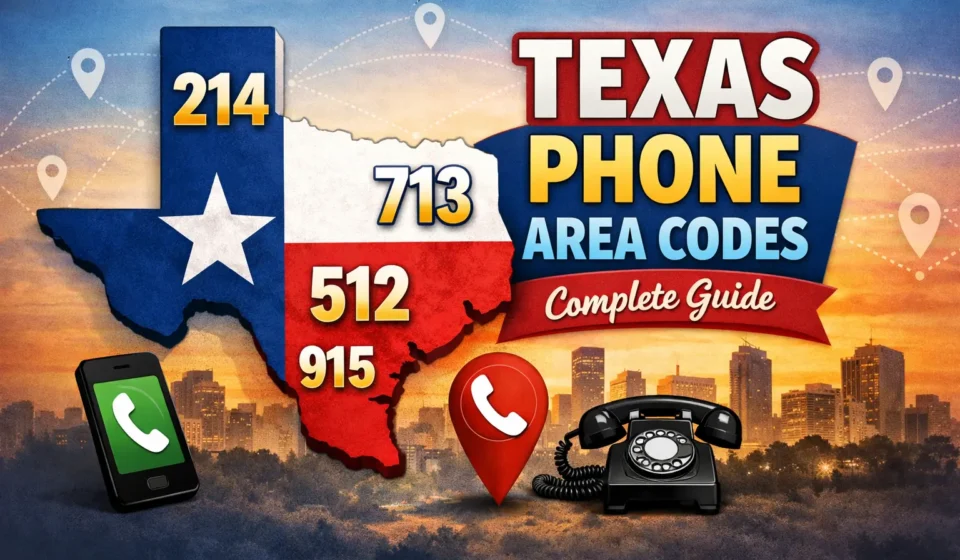

Texas is one of the largest and most populated states in the United States, and with that size comes a large and complex phone numbering system. If you’ve ever received a call from a number starting with 214, 713, or 512, you were likely contacted from Texas.
Understanding Texas phone area codes is useful for individuals, businesses, marketers, and anyone who frequently communicates with people across the state. Whether you’re trying to identify a caller, set up a business phone system, or simply learn how area codes work, this guide covers everything you need to know.
In this comprehensive guide, we’ll explore:
-
What Texas phone area codes are
-
Why multiple area codes exist
-
The complete list of Texas area codes
-
Cities covered by each code
-
Overlay systems and dialing rules
-
How businesses use area codes strategically
-
Risks such as phone scams and spoofing
Let’s begin with the basics.
What Is a Texas Phone Area Code?
A Texas phone area code is the three-digit prefix used at the beginning of a 10-digit phone number to identify a geographic calling region within Texas.
A standard U.S. phone number looks like this:
(AAA) BBB-CCCC
Example:
-
512 → Texas area code
-
555 → Local exchange
-
1234 → Individual line
The area code tells telecom systems where the number is registered geographically.
Originally, area codes helped route calls through physical telephone switches. Today they still identify regional identity, even though modern mobile phones can work anywhere.
Why Texas Has So Many Area Codes
Texas currently has more than 25 active area codes, and new ones occasionally get introduced.
Several factors explain why the number keeps growing.
1. Massive Population Growth
Texas is one of the fastest-growing states in the U.S.
Major cities such as:
-
Houston
-
Dallas
-
Austin
-
San Antonio
have experienced rapid population expansion, increasing the demand for phone numbers.
2. Explosion of Mobile Devices
In the past, households had one landline phone.
Today, individuals may have:
-
Personal smartphones
-
Business phones
-
Tablets with cellular data
-
Smartwatches
-
VoIP lines
Each device may require its own phone number.
3. Business Communication Systems
Modern businesses use large phone systems including:
-
Customer support numbers
-
Sales lines
-
department extensions
-
marketing call tracking numbers
This dramatically increases the number of required phone numbers.
4. Number Exhaustion
Every area code has a finite supply of numbers.
Once most numbers are assigned, telecom regulators introduce:
-
New overlay area codes
-
Split regions
Texas now mostly uses overlays, which allow multiple area codes in the same region.
Complete List of Texas Phone Area Codes
Below is a table of major Texas phone area codes and the regions they serve.
| Area Code | Major Cities | Region |
|---|---|---|
| 210 | San Antonio | South Texas |
| 214 | Dallas | North Texas |
| 254 | Waco, Killeen | Central Texas |
| 281 | Houston suburbs | Southeast Texas |
| 325 | Abilene, San Angelo | West Central Texas |
| 346 | Houston overlay | Southeast Texas |
| 361 | Corpus Christi | Gulf Coast |
| 409 | Beaumont, Galveston | Southeast Texas |
| 430 | East Texas overlay | East Texas |
| 432 | Midland, Odessa | West Texas |
| 469 | Dallas overlay | North Texas |
| 512 | Austin | Central Texas |
| 682 | Fort Worth overlay | North Texas |
| 713 | Houston | Southeast Texas |
| 726 | San Antonio overlay | South Texas |
| 737 | Austin overlay | Central Texas |
| 806 | Amarillo, Lubbock | Panhandle |
| 817 | Fort Worth | North Texas |
| 830 | Hill Country | Central Texas |
| 832 | Houston overlay | Southeast Texas |
| 903 | Tyler, Sherman | East Texas |
| 915 | El Paso | West Texas |
| 936 | Huntsville | East Texas |
| 940 | Denton, Wichita Falls | North Texas |
| 945 | Dallas overlay | North Texas |
| 956 | Laredo, McAllen | South Texas |
| 972 | Dallas suburbs | North Texas |
| 979 | College Station | Central Texas |
This large list shows how extensive Texas telecommunications coverage is.
Major Texas Area Codes Explained
Let’s explore some of the most well-known Texas area codes.
214 Area Code (Dallas)
The 214 area code is one of the original area codes in Texas.
Key Details
-
Primary city: Dallas
-
Region: North Texas
-
Introduced: 1947
Over time, rapid growth forced additional overlays including:
-
469
-
972
-
945
Today all these codes serve the Dallas metropolitan area.
713 Area Code (Houston)
The 713 area code is historically tied to Houston.
Coverage
-
Downtown Houston
-
Inner metropolitan areas
Due to population growth, Houston now uses additional overlays:
-
281
-
832
-
346
Together these support millions of phone numbers across the Houston metro area.
512 Area Code (Austin)
The 512 area code serves Austin and surrounding communities.
Austin’s booming tech sector dramatically increased demand for numbers.
To accommodate growth, 737 was introduced as an overlay.
Cities covered include:
-
Austin
-
Round Rock
-
San Marcos
-
Georgetown
210 Area Code (San Antonio)
The 210 area code covers the San Antonio region.
Because of demand, 726 was later added as an overlay.
This region includes:
-
San Antonio
-
New Braunfels
-
Schertz
-
Seguin
915 Area Code (El Paso)
The 915 area code serves West Texas.
Major cities include:
-
El Paso
-
Socorro
-
Horizon City
It’s one of the geographically largest coverage areas in Texas.
Understanding Overlay Area Codes
An overlay area code occurs when a new area code is added to the same geographic region as an existing one.
Instead of splitting regions, overlays allow multiple area codes in the same city.
Example:
Houston uses:
-
713
-
281
-
832
-
346
Two neighbors might live on the same street but have different area codes.
10-Digit Dialing in Texas
Because of overlays, 10-digit dialing is mandatory in most Texas regions.
Instead of dialing:
You must dial:
(512) 555-1234
This ensures calls route correctly across overlapping codes.
How Businesses Use Texas Area Codes
Area codes play a surprisingly large role in business strategy.
1. Building Local Trust
Customers are more likely to answer calls from local area codes.
Example:
A Dallas business may prefer 214 or 469 numbers.
2. Regional Marketing
Businesses can track marketing campaigns using different area codes.
Example:
-
713 → Houston campaign
-
512 → Austin campaign
-
214 → Dallas campaign
Each phone number reveals which region produced the lead.
3. Call Routing
Modern phone systems route calls based on area codes.
Example:
Austin calls → Austin sales team
This improves response time and customer experience.
Benefits of Understanding Texas Area Codes
Knowing Texas area codes offers several advantages.
For Individuals
-
Identify where calls originate
-
Recognize unfamiliar numbers
-
Avoid scams
For Businesses
-
Local presence marketing
-
Regional campaign tracking
-
Improved customer communication
For Researchers and Analysts
-
Population distribution insights
-
Telecommunications infrastructure planning
Risks and Issues with Area Codes
While useful, area codes can also create problems.
Phone Number Spoofing
Scammers often spoof local area codes to trick people into answering calls.
Example:
You may see a local 512 number, but the call could originate anywhere in the world.
Robocalls
Certain area codes get targeted heavily for robocalls.
Common scam patterns include:
-
Fake IRS calls
-
Warranty scams
-
Loan offers
-
Tech support fraud
Area Code Confusion
Because of overlays, people sometimes assume a phone number belongs to a specific city when it may not.
Mobile phones allow users to keep numbers even after moving.
How to Identify a Texas Phone Number
To determine whether a number belongs to Texas:
Step 1
Check the first three digits.
Step 2
Match it with known Texas area codes.
Step 3
Confirm the associated region.
Example:
(512) 555-0000 → Austin
(915) 555-0000 → El Paso
Texas Area Codes by Region
North Texas
-
214
-
469
-
972
-
817
-
682
-
940
Major cities:
-
Dallas
-
Fort Worth
-
Denton
Central Texas
-
512
-
737
-
254
-
979
Major cities:
-
Austin
-
Waco
-
College Station
South Texas
-
210
-
726
-
956
Major cities:
-
San Antonio
-
Laredo
-
McAllen
East Texas
-
903
-
430
-
936
Major cities:
-
Tyler
-
Longview
West Texas
-
915
-
432
Major cities:
-
El Paso
-
Midland
-
Odessa
Gulf Coast
-
713
-
281
-
832
-
346
-
409
-
361
Major cities:
-
Houston
-
Corpus Christi
-
Galveston
History of Texas Area Codes
Originally, Texas had only four area codes.
Original Texas Codes
-
214
-
512
-
713
-
915
These were introduced in 1947 when the North American Numbering Plan was created.
As Texas grew, these regions were repeatedly divided or overlaid to accommodate more numbers.
Today the state has one of the largest numbering systems in the U.S.
Future of Texas Phone Area Codes
Demand for phone numbers continues increasing.
Several trends may shape the future:
More Overlay Codes
Large cities may receive additional overlays.
Growth of VoIP Numbers
Businesses increasingly use cloud phone systems.
Reduced Geographic Importance
Mobile devices mean numbers no longer strictly reflect location.
Quick Summary: Texas Phone Area Codes
Key facts:
-
Texas has 25+ active area codes
-
Major cities have multiple overlay codes
-
10-digit dialing is required in most regions
-
Area codes help identify call origin
-
Businesses use them for marketing and routing
FAQs (People Also Ask)
What is the most common Texas area code?
Some of the most recognized Texas area codes include 214 (Dallas), 713 (Houston), 512 (Austin), and 210 (San Antonio) because they serve major metropolitan areas.
How many phone area codes does Texas have?
Texas currently has over 25 active area codes, making it one of the states with the largest numbering systems in the United States.
Can two people in the same Texas city have different area codes?
Yes. Due to overlay systems, multiple area codes may serve the same geographic region. For example, Houston uses 713, 281, 832, and 346.
Why do I need to dial the area code for local calls?
When multiple area codes exist in the same region, 10-digit dialing is required to ensure calls are routed correctly.
Can a Texas phone number move to another state?
Yes. Mobile numbers can be ported, meaning the owner can keep the same number even after relocating.
Conclusion
Texas phone area codes reflect the massive scale and growth of the state’s population and communication networks. What began with just four area codes has evolved into a complex system of more than 25 codes serving millions of residents and businesses.
Understanding these codes helps individuals identify incoming calls, businesses build regional presence, and organizations manage communication more efficiently. From the historic 214 code in Dallas to the rapidly growing Austin and Houston overlays, each area code represents a piece of Texas’s telecommunications landscape.
As mobile technology and digital phone systems continue expanding, Texas will likely see even more overlays and numbering innovations in the future.
Actionable Takeaways
-
Save common Texas area codes to recognize incoming calls
-
Use local area codes for better business trust
-
Be cautious of spoofed calls that appear local
-
Always dial 10 digits for Texas numbers
-
Monitor new overlays as Texas population continues growing